
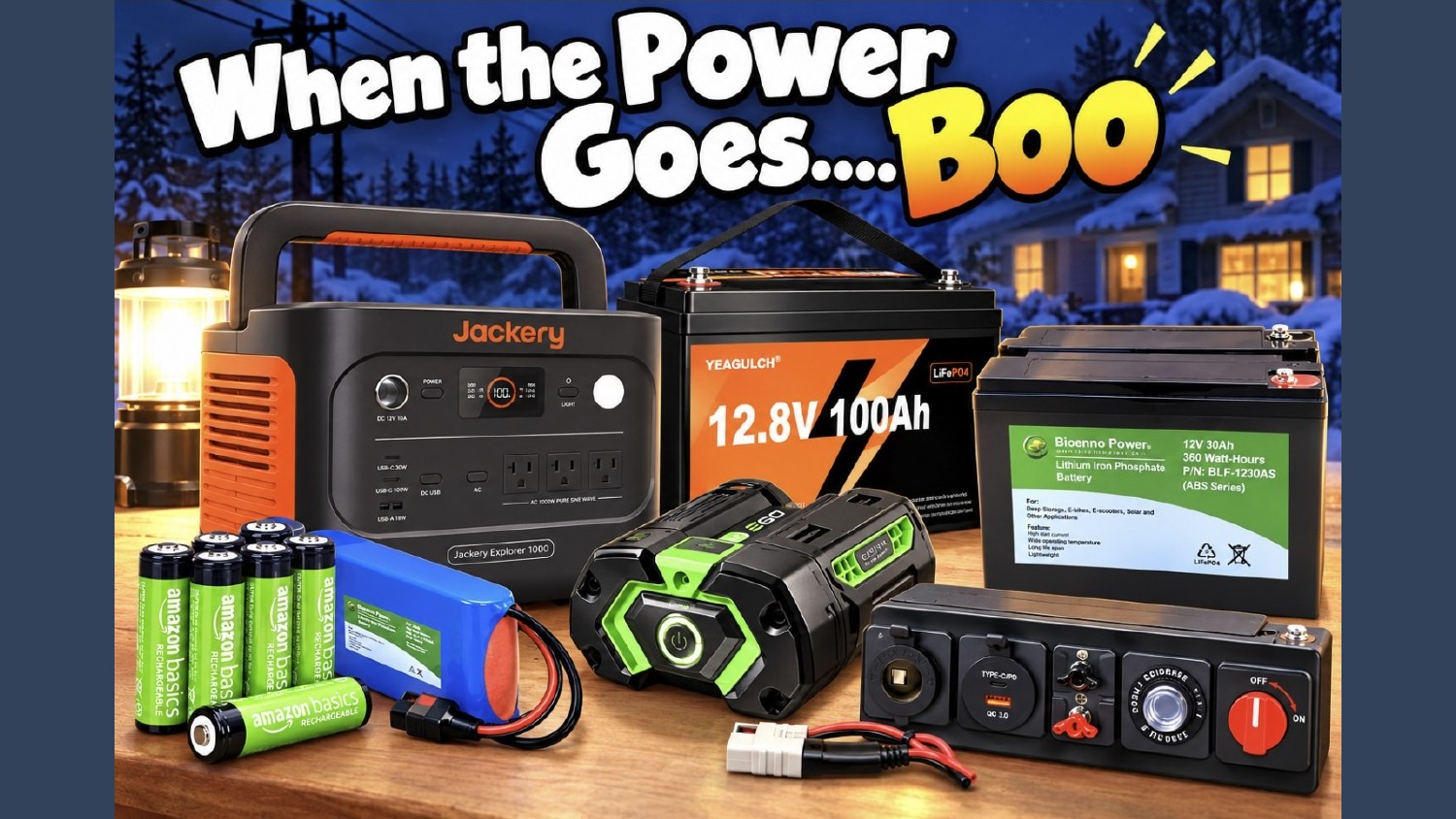
 SAN BRUNO — With a strengthening El Niño on the way and neighborhood outages still fresh in members' minds, the San Bruno Amateur Radio Club devoted its October meeting to a question every household faces as winter approaches: what does it take to keep your radios on the air and your house livable if the power goes out for three days? Club president Dave Dornlas, KN6KOO, led the evening's presentation, "When the Power Goes... Boo," which ran from the arithmetic of how much power your gear uses to batteries, power stations, generators, solar, and what to run first in the house. Ralph Kugler, KC6YDH, followed with a demonstration of a new free app for digital radio.
Why Plan Now
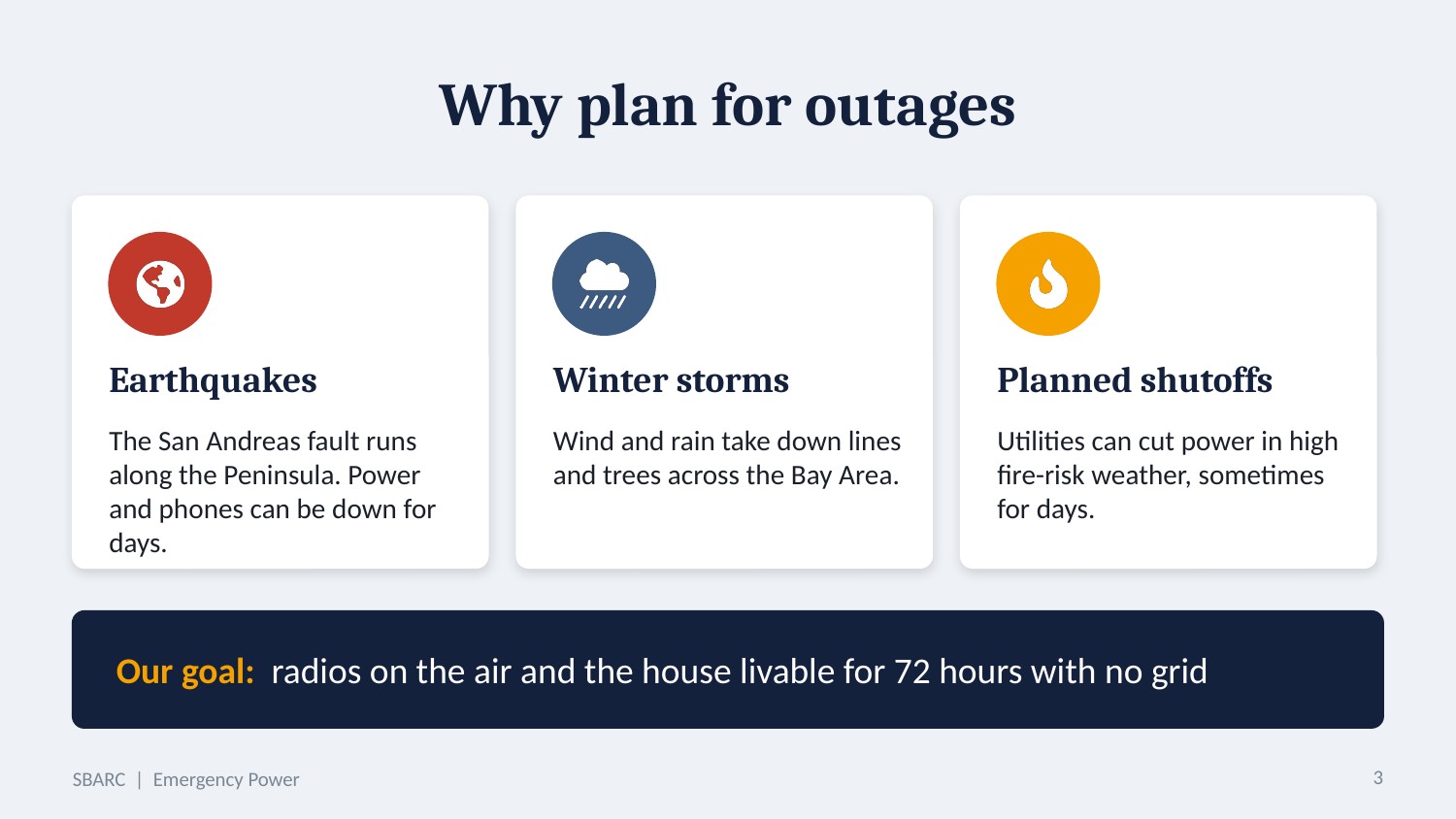
Dornlas pointed to the El Niño building in the Pacific, with ocean temperatures in the key region running more than two degrees above normal and forecasters expecting a hard winter. But he stressed that outages do not wait for bad weather. A member in the Shelter Creek area had just been spared an outage that hit some of his neighbors early Sunday morning.
Dornlas recalled a far longer one in the 1990s, when a pole behind a neighbor's house on Princeton Avenue came down on a major feeder line and the power stayed off for three days. The novelty, he said, wears off fast. The family was fortunate to have in-laws up the hill on Crestmoor, where they could shower and warm up.
The risks are familiar. The Peninsula is earthquake country. Winter storms bring down lines and trees. And as happened in Maui while Dornlas was in Hawaii, utilities sometimes cut power on purpose when the wind picks up. That shutoff lasted two days. The goal he set for the evening: radios on the air and the house livable for 72 hours with no grid.
Speaking the Same Language
Before the numbers, Dornlas ran through the vocabulary. Most of it will be familiar to anyone who studied for a license: volts, watts, watt-hours, amp-hours, and duty cycle, the share of time a radio spends transmitting. On the battery side, LiFePO4 is the safe, long-lived lithium chemistry common in deep-cycle batteries, AGM (absorbed glass mat) is a sealed lead-acid type, and a BMS, or battery management system, guards a battery against overcharging, over-draining, and short circuits.
He admitted that MPPT was new to him, and he asked Claude to explain it. It stands for Maximum Power Point Tracking, a type of solar charge controller that gets the most energy out of a panel. Its cheaper cousin, PWM, harvests less. The list went on to inverters, which turn 12-volt battery power into household AC; RFI, the electrical noise that shows up in a receiver; Anderson Powerpoles, the standard ham DC connector; transfer switches and interlocks; and backfeed, generator power flowing out onto utility lines, which shocks line crews.
Know Your Loads: Do the Math First
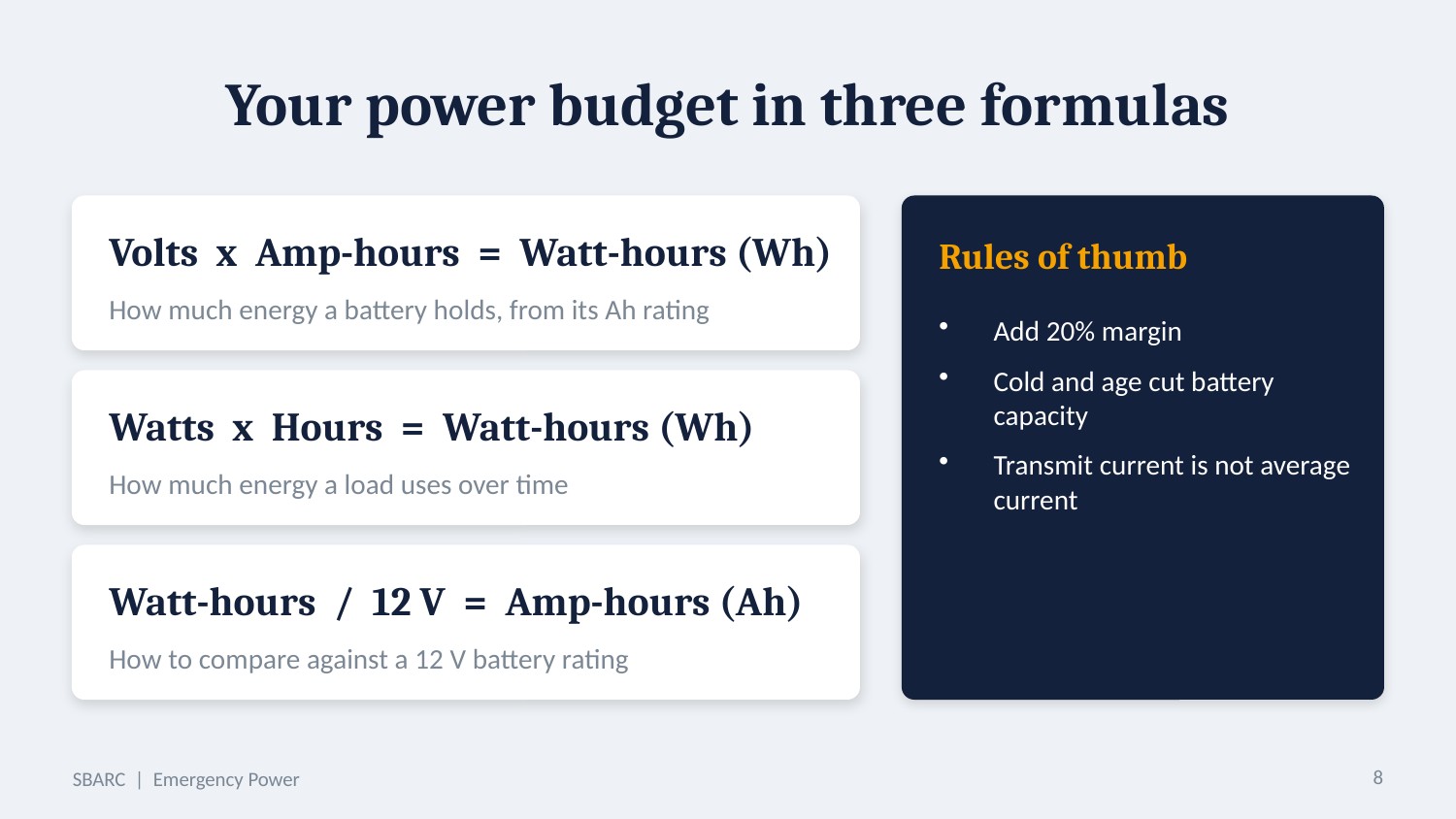 Dornlas took members back to the basics from their Technician exams. Volts times amp-hours gives watt-hours, the energy a battery holds. Watts times hours gives the watt-hours a load consumes. Watt-hours divided by 12 gives the amp-hours to compare against a 12-volt battery. His rules of thumb: add a 20 percent margin, remember that cold and age cut battery capacity, and keep in mind that transmit current is not average current.
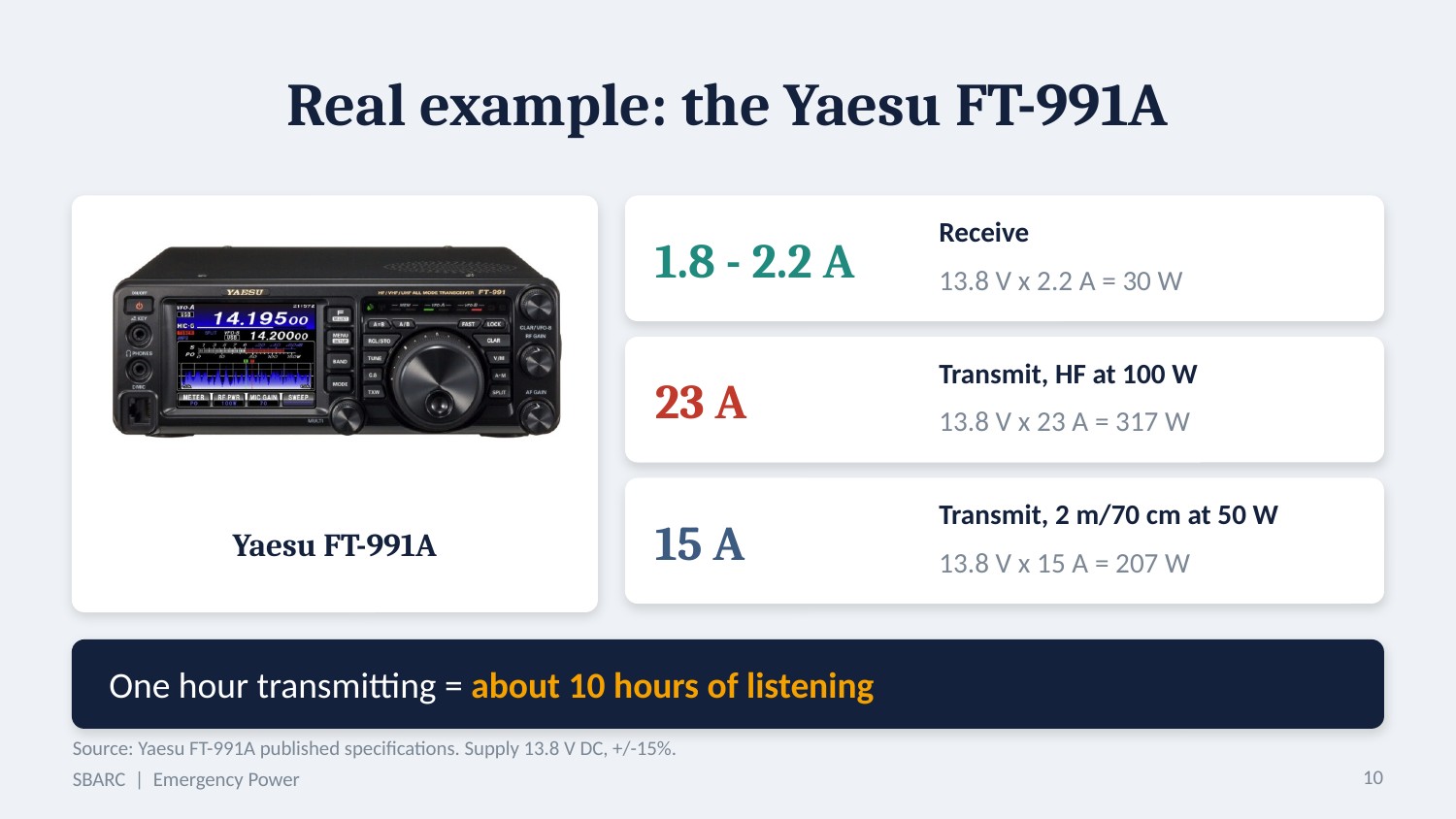
He then put real numbers on a radio several members own, the Yaesu FT-991A, which he uses for the Monday night nets. Yaesu's published figures at 13.8 volts are about 1.8 to 2.2 amps on receive, roughly 30 watts, and 23 amps, about 317 watts, when transmitting 100 watts on HF. On 2 meters and 70 centimeters at 50 watts it draws about 15 amps. The takeaway: one hour of transmitting uses about as much energy as ten hours of listening. That is why duty cycle, not rated power, drives battery size. As a member noted, a radio's power can also be dialed back, and running 50 or 75 watts instead of 100 stretches a battery noticeably.
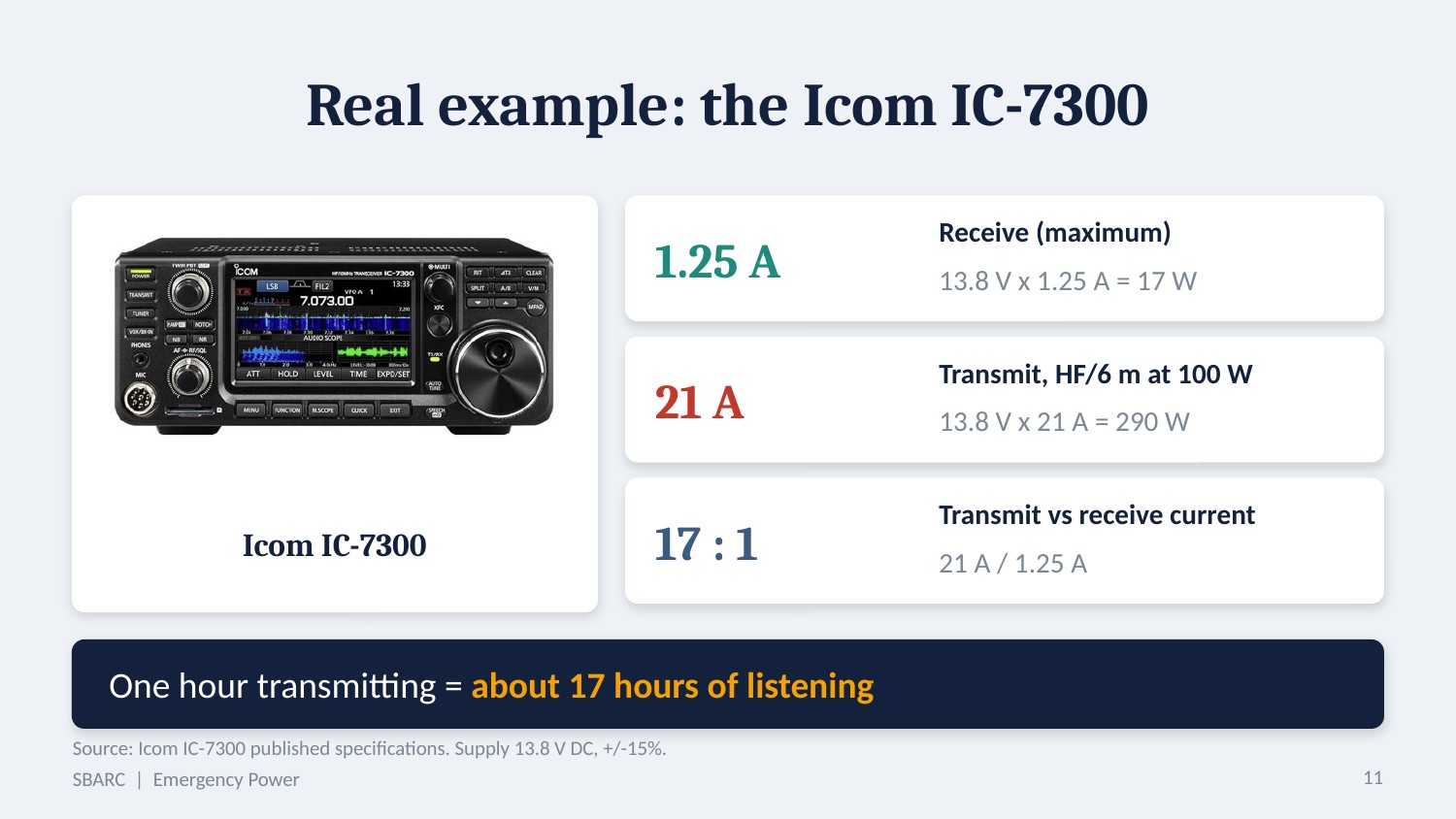
Two members, Steve and Ralph, own the Icom IC-7300, which is a bit more frugal: about 1.25 amps maximum on receive and 21 amps transmitting 100 watts. The ratio is steeper, roughly 17 to 1, so an hour of transmitting equals about 17 hours of listening. Unlike the FT-991A, the IC-7300 covers HF and 6 meters only, with no VHF or UHF.
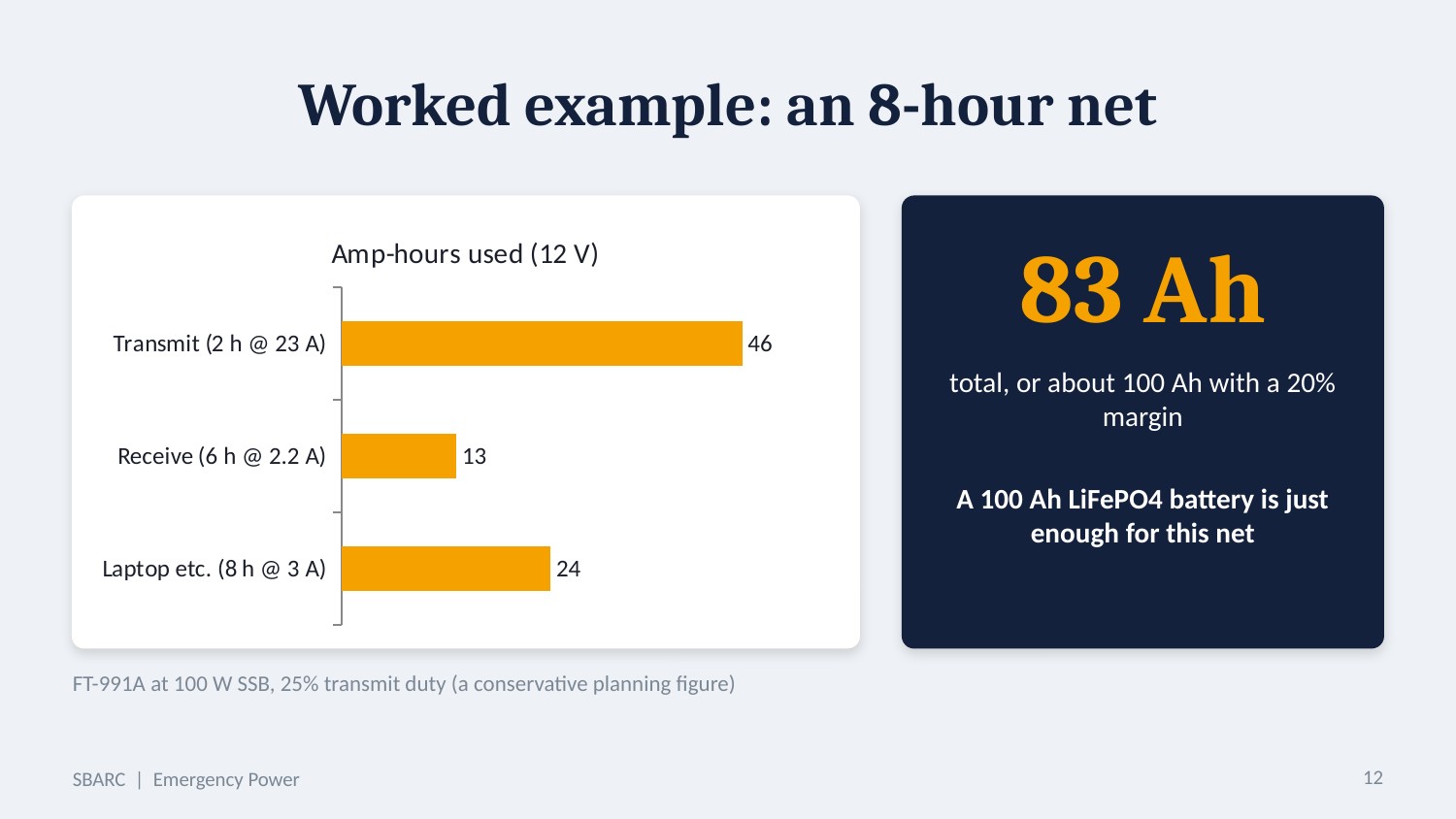
Putting it together, Dornlas sized a battery for an eight-hour net with a quarter of the time spent transmitting, a deliberately conservative assumption: 46 amp-hours for transmitting, 13 for receiving, and 24 for a laptop and accessories, about 83 amp-hours in all. With the 20 percent margin that is right around 100 amp-hours, so a 100 amp-hour lithium battery is just enough. A laptop is not required to operate, he noted. It simply makes the example more realistic.
The 12-Volt Shack: Batteries, Fuses and Connectors
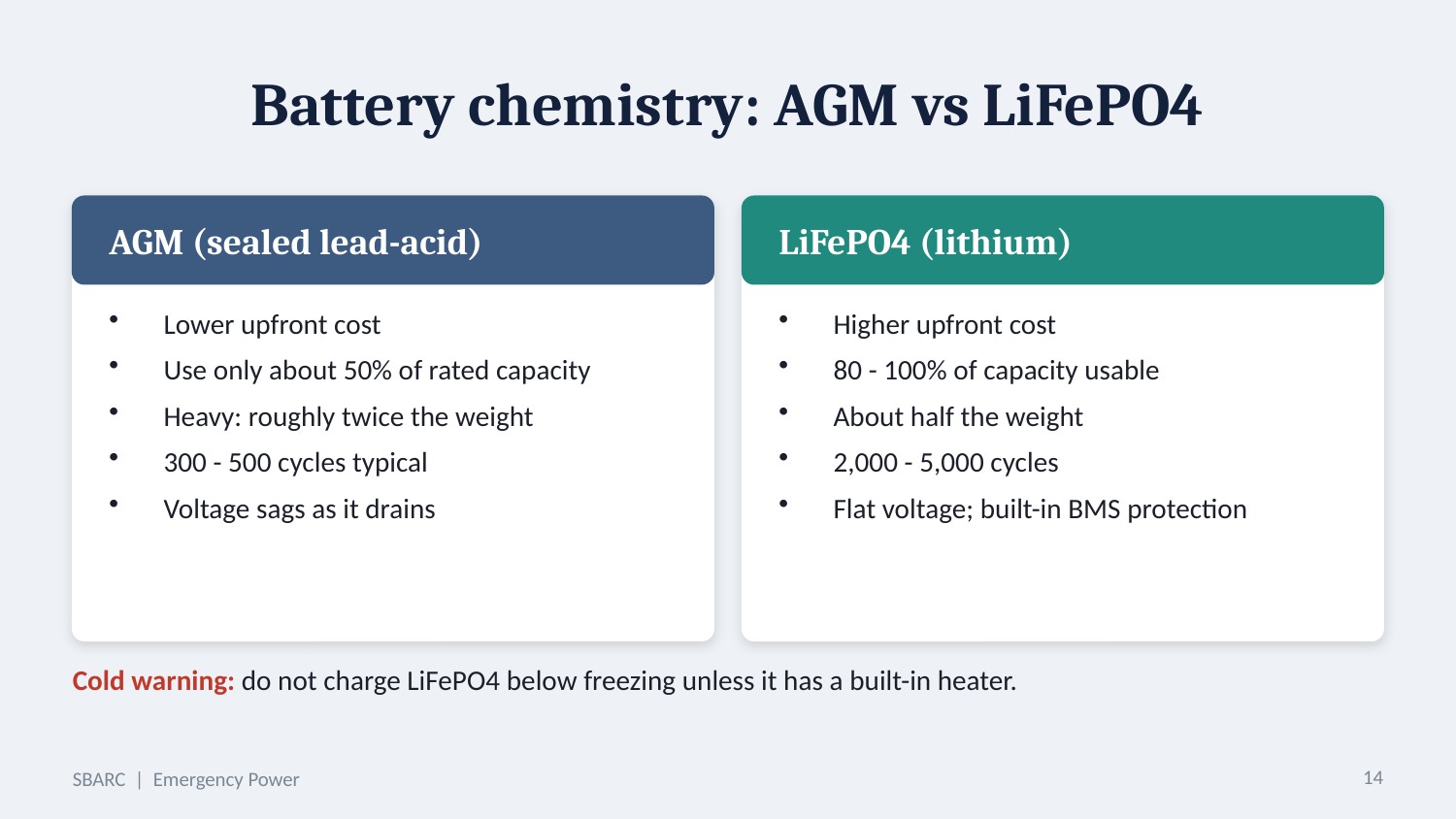
Dornlas compared the two common battery choices. AGM costs less up front, but only about half its rated capacity is usable, it is heavy, and it is good for a few hundred cycles. LiFePO4 costs more, but 80 to 100 percent of its capacity is usable, it weighs about half as much, it is rated for thousands of cycles, and it has a built-in BMS. The caution is cold: LiFePO4 batteries should not be charged below freezing, though some include heaters. For the eight-hour net, the answer works out to about 110 amp-hours of lithium or 200 of AGM.
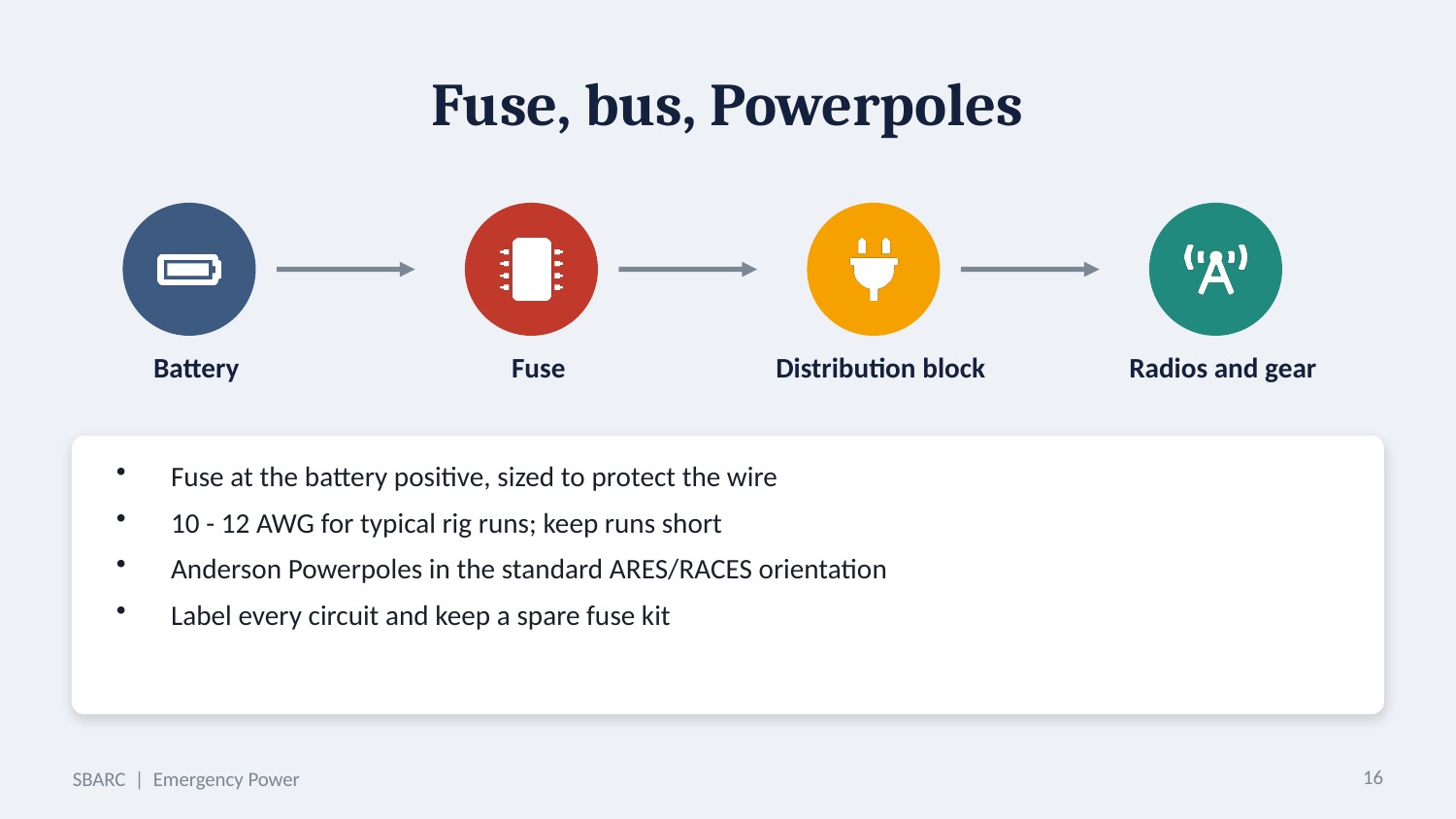
Wiring matters as much as the battery. His chain runs from the battery through a fuse, to a distribution block, and on to the radios. Fuse at the battery's positive terminal, sized to protect the wire; 10 to 12 AWG for typical rig runs, kept short; Anderson Powerpoles in the standard ARES/RACES orientation; every circuit labeled; and a spare fuse kit on hand. He floated a club workshop on Powerpoles.
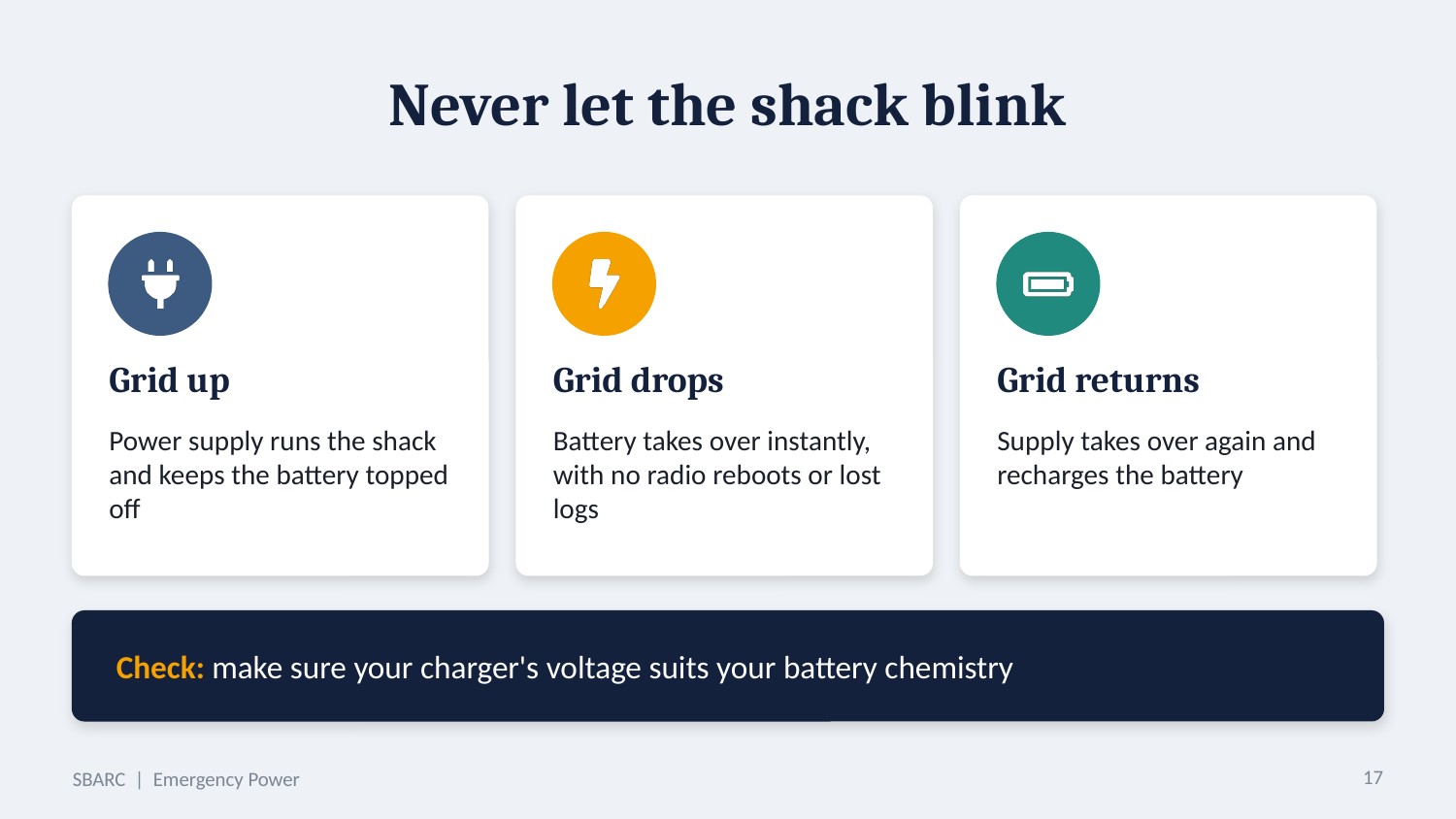
The best setups switch over so smoothly that nothing notices an outage. Kugler described his own: a power supply feeds a Powerwerx PWRgate-style unit that charges the battery and switches over automatically. When the grid drops, the battery takes over instantly with no radio reboots or lost logs, and when the grid returns the supply takes over again. Dornlas called it a model setup, with one reminder: match your charger's voltage to your battery's chemistry, since a plain 13.8-volt supply may not fully charge a lithium battery.
Power Stations: Convenient, With One Catch
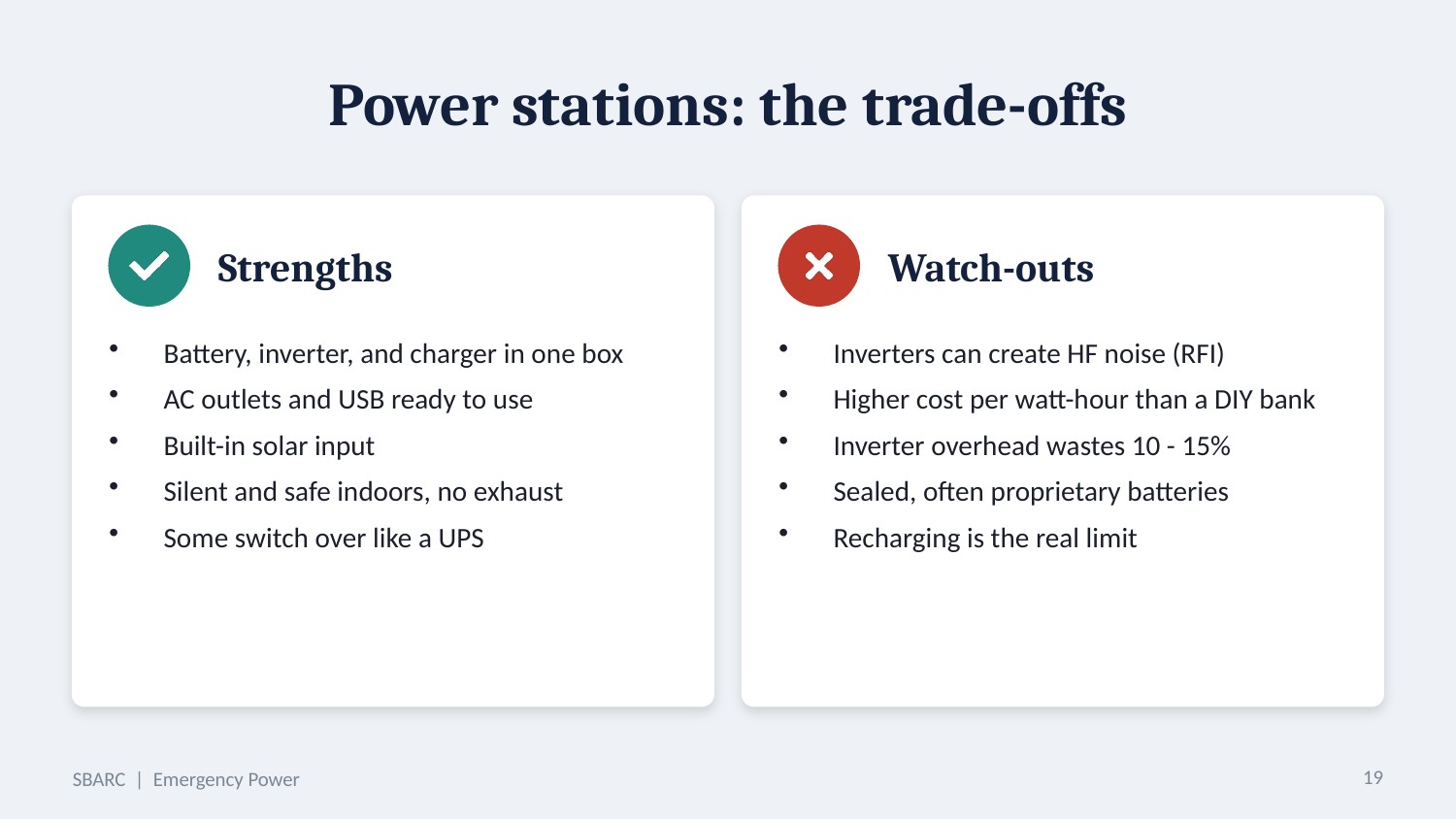
Portable power stations, a battery, inverter, and charger in one box, drew plenty of discussion, with several members owning EcoFlow, Jackery, or larger units. Dornlas's is about 3,200 watt-hours, bundled when he bought it with 600 watts of solar panels, and its first job in an outage is the refrigerator. Another member described a much bigger stacked system, with a main unit and two expansion batteries, in the neighborhood of 10,000 watt-hours.
The advantages are real: AC outlets and USB ports ready to use, built-in solar input, silence, and no exhaust, so they are safe indoors. The catch is noise. Inverters can create RFI that shows up as hash across the HF bands. They also cost more per watt-hour than a DIY battery bank, waste 10 to 15 percent of the energy in the inverter, often use sealed proprietary batteries, and take a long time to recharge.
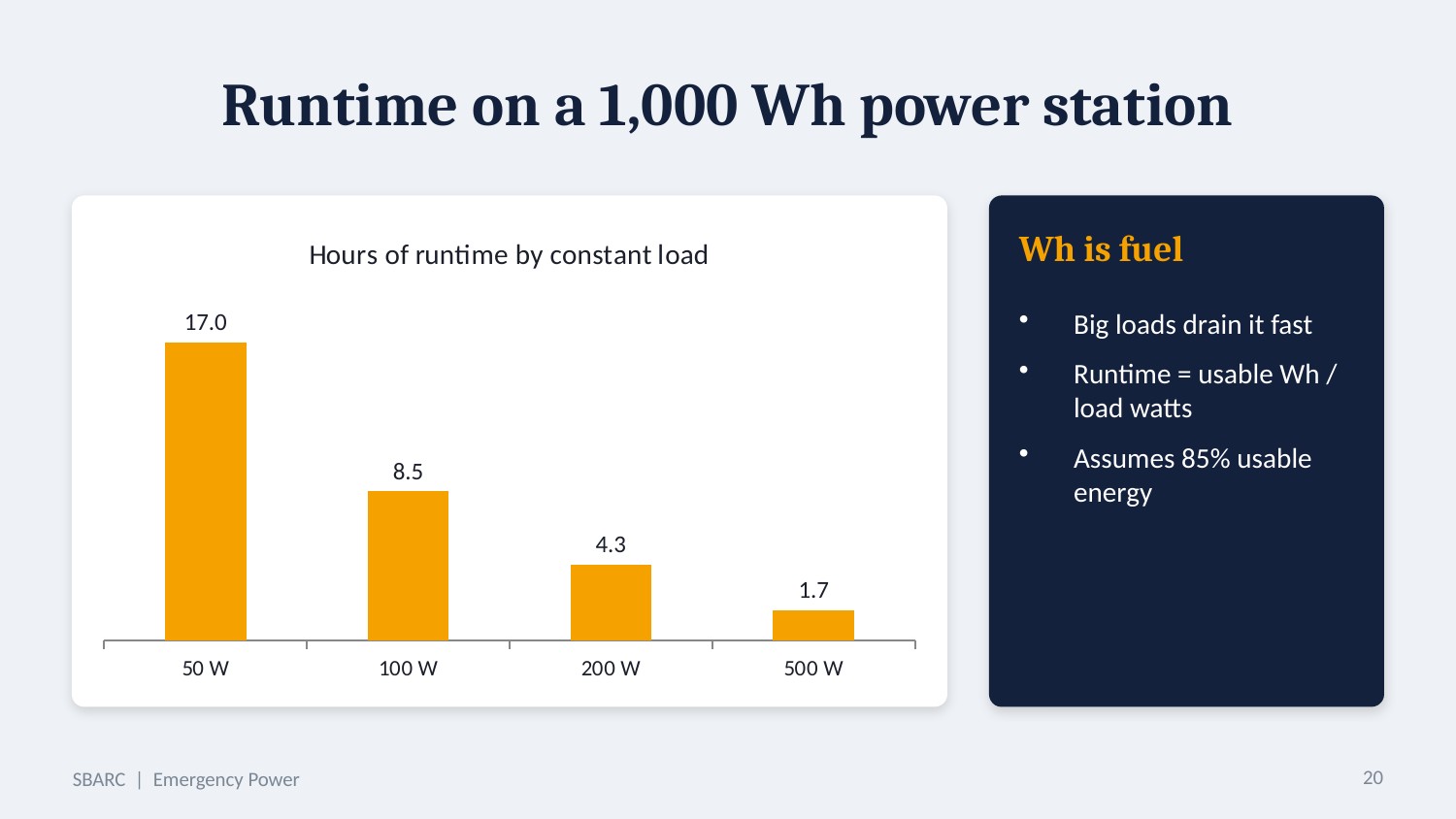 For planning, Dornlas showed how long a 1,000 watt-hour station lasts, assuming about 85 percent usable: roughly 17 hours at 50 watts, 8.5 hours at 100 watts, and 4.3 hours at 200 watts. His 3,200 watt-hour unit gives about three times that.
His advice for hams: use the station's DC output when possible. On his unit, Powerpoles on the back let him power a radio directly and skip the inverter and its noise. Test for noise before the emergency by listening across the HF bands with the station running, and add ferrite chokes if needed. And keep it charged: top it off every few months and store it partly charged, or do as Dornlas does and keep it plugged in with his laptop sitting on it, so it always has a trickle.
From Lawn Mower to Lifeline: Tool Batteries as Backup
The most talked-about idea of the evening started with Dornlas's hip surgery. Afterward he wanted to get back outside and mow his own lawn rather than hire it out, but his corded electric mower was a tripping and cord-cutting hazard. He bought a self-propelled EGO mower that runs on 56-volt batteries. It came with two, a 5 amp-hour and a 4, and mowing the front and back lawns uses about a third of one. Then came an edger and, after his old power washer died in the middle of refinishing the deck, a battery-powered EGO washer. He had three batteries.
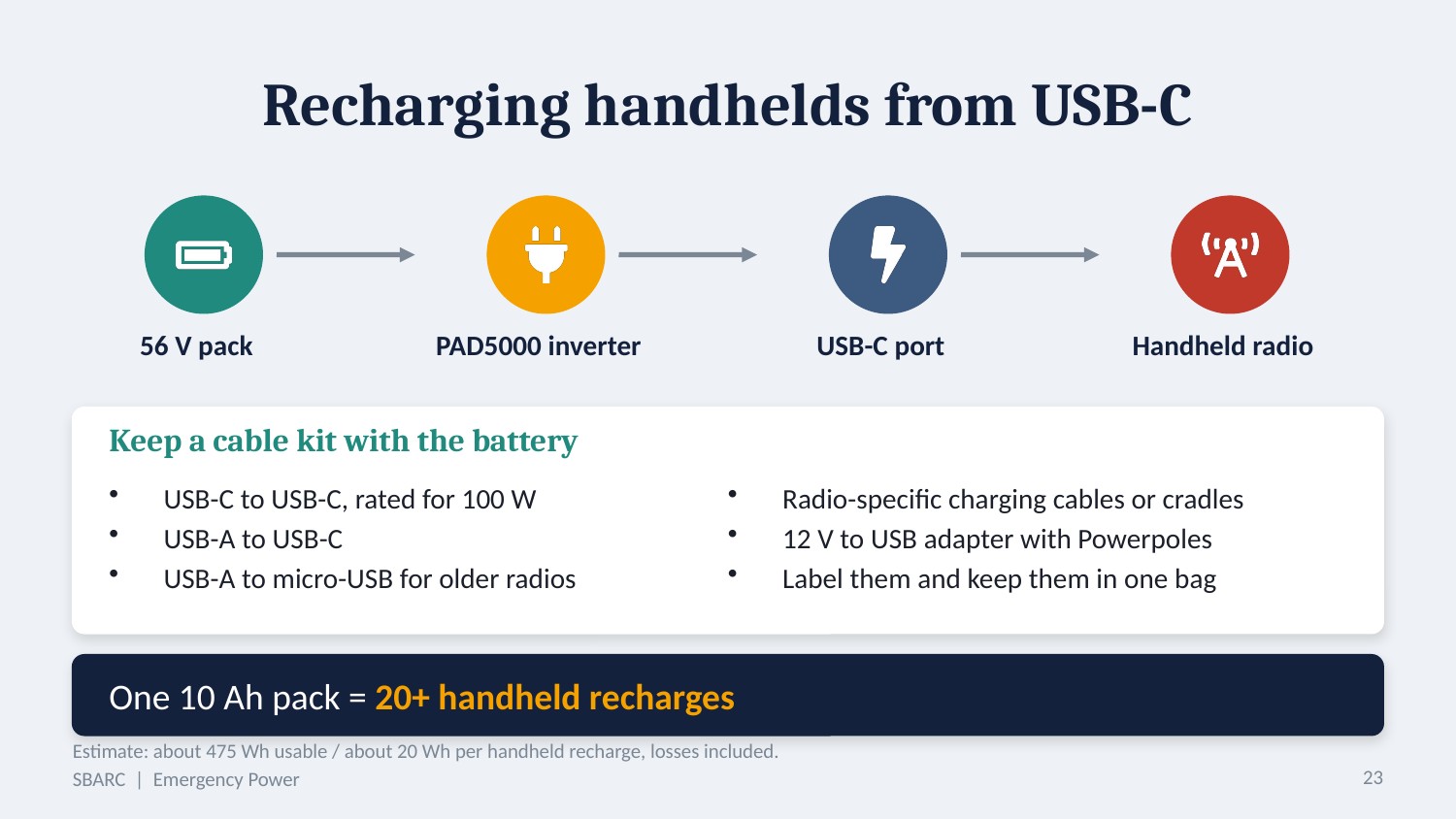
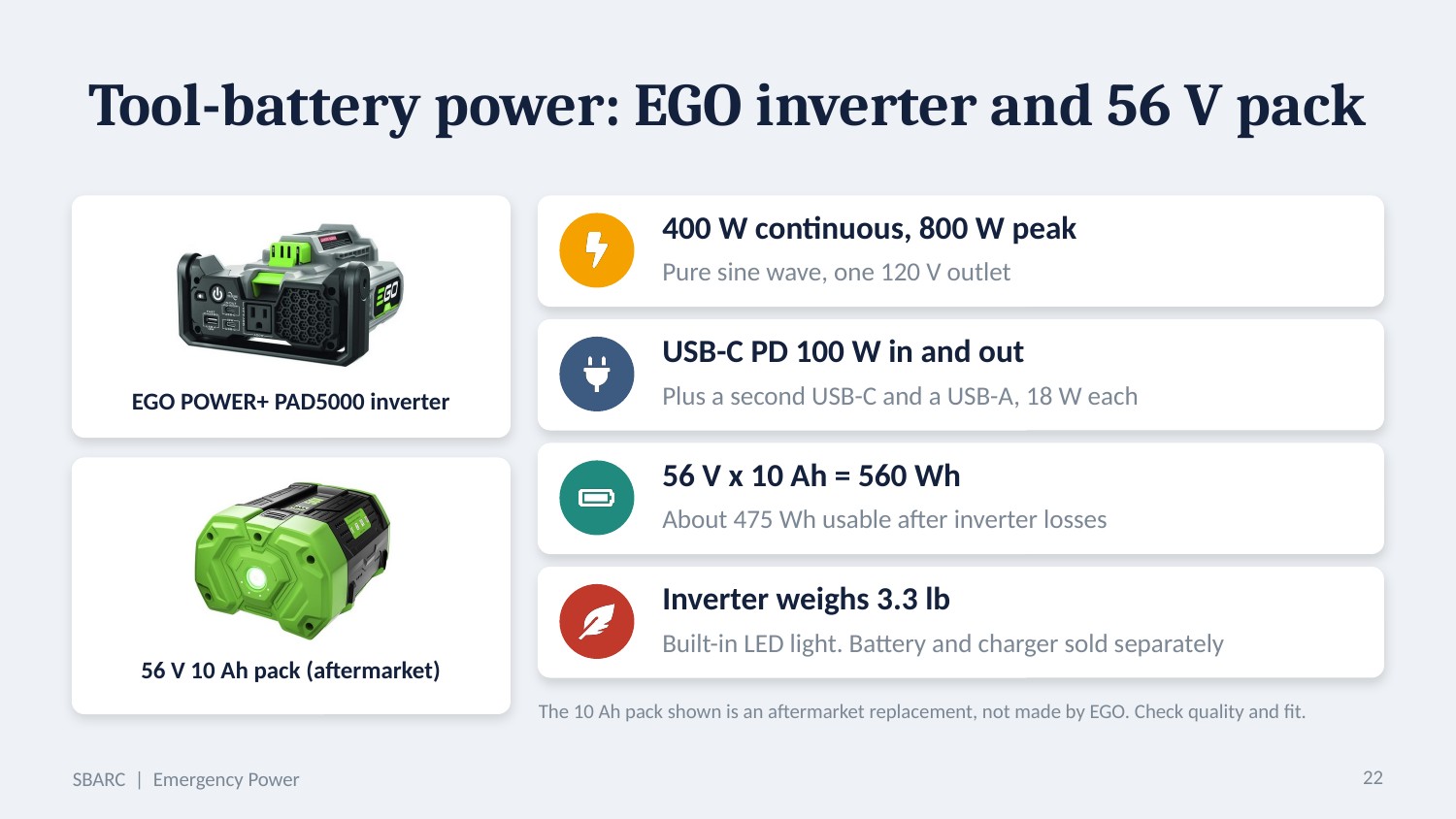
That is when it occurred to him that he already owned a lot of stored energy. A 4 amp-hour pack at 56 volts holds about 224 watt-hours. He explained the idea to his wife, who bought him the missing piece, an EGO POWER+ PAD5000 inverter, on sale on Prime Day for about $122 without a battery. He also bought an aftermarket 10 amp-hour pack that cost much less than the name brand. The inverter delivers 400 watts continuously, 800 at peak, as pure sine wave from one 120-volt outlet, and it has a 100-watt USB-C power-delivery port that works in both directions, a second USB-C port, and a USB-A port. It weighs about 3.3 pounds. A 10 amp-hour, 56-volt pack holds 560 watt-hours.
Dornlas does not see it as a replacement for a generator or a large power station. As a backup he finds it compact, quiet, and handy. He imagines using it to run his wife's lamp and a small warmer for her feet while the big power station keeps the refrigerator cold. He has not yet tried feeding it from solar, although its USB-C port can accept charging.
His demonstration was the most practical part. Nearly all newer handhelds charge over USB-C, so he plugged his Radtel RT-950 Pro straight into the inverter and started charging, which in an emergency may matter more than running an HF radio. The same ports can charge a phone, and the second USB-C port can run a Meshtastic node at the same time. The catch is cables. He urged members to keep a labeled bag with 100-watt-rated USB-C to USB-C cables, USB-A to USB-C, USB-A to micro-USB for older gear, radio-specific charging cables or cradles, and a 12-volt to USB adapter with Powerpoles.
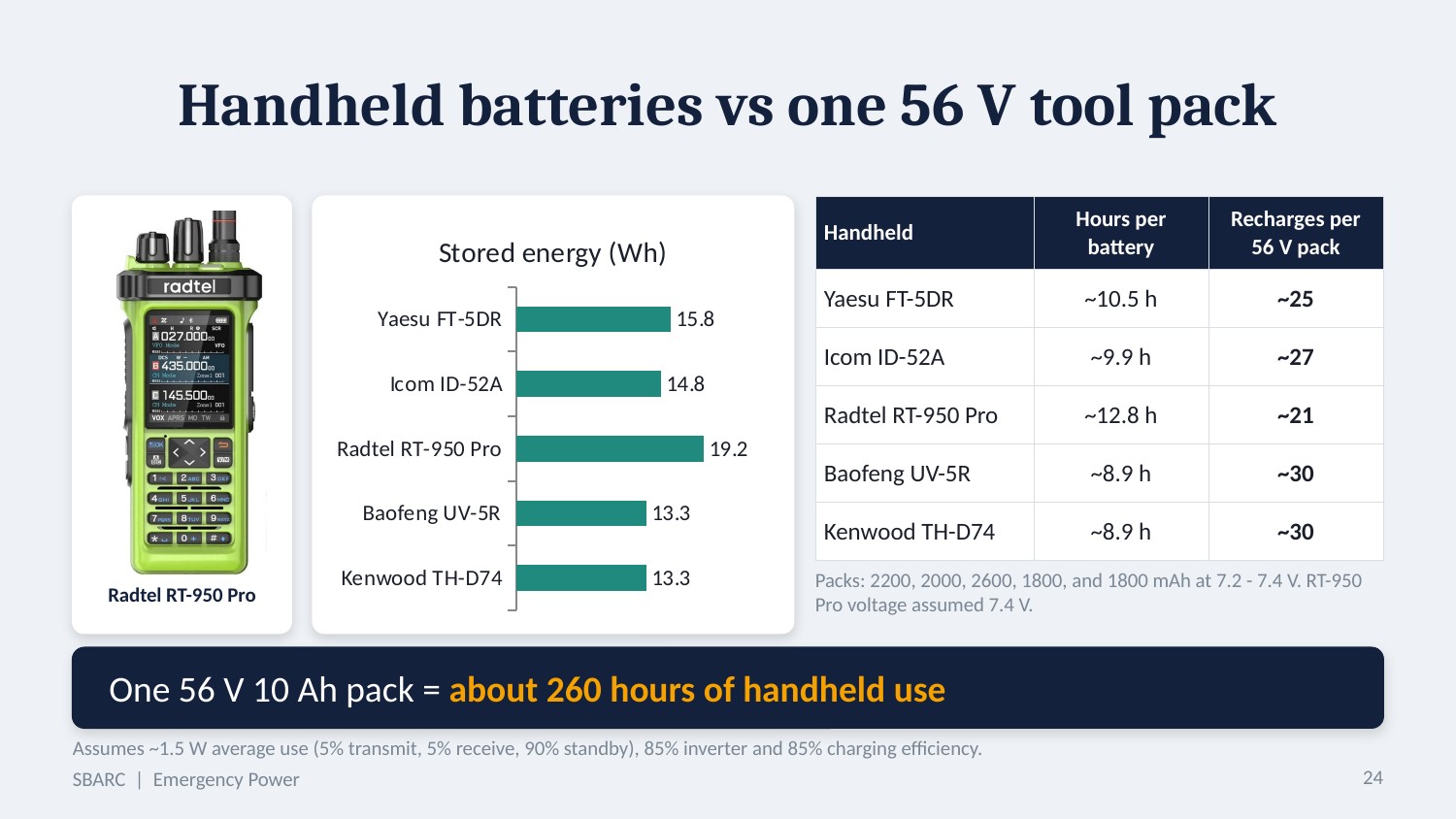
How far does a tool battery go? Dornlas compared the energy in common handhelds: about 15.8 watt-hours in a Yaesu FT-5DR, 14.8 in an Icom ID-52A, 19.2 in a Radtel RT-950 Pro, and 13.3 each in a Baofeng UV-5R and a Kenwood TH-D74. After inverter and charging losses, one 10 amp-hour pack can recharge a handheld roughly 21 to 30 times, depending on the radio, for about 260 hours of use, more than ten days. Those hours assume an average of about 1.5 watts, with 5 percent transmit, 5 percent receive, and 90 percent standby. Transmitting constantly at 5 watts would drain any of them in under an hour.
Generators: Gasoline, Propane and California's Rules
Several members own generators. Dornlas has a dual-fuel inverter model. Inverter generators are quiet, fuel-efficient, and produce clean power that suits electronics, which makes them the best fit for a ham shack. Open-frame generators are cheap per watt but loud, and standby generators, running on natural gas or propane, start automatically but cost the most.
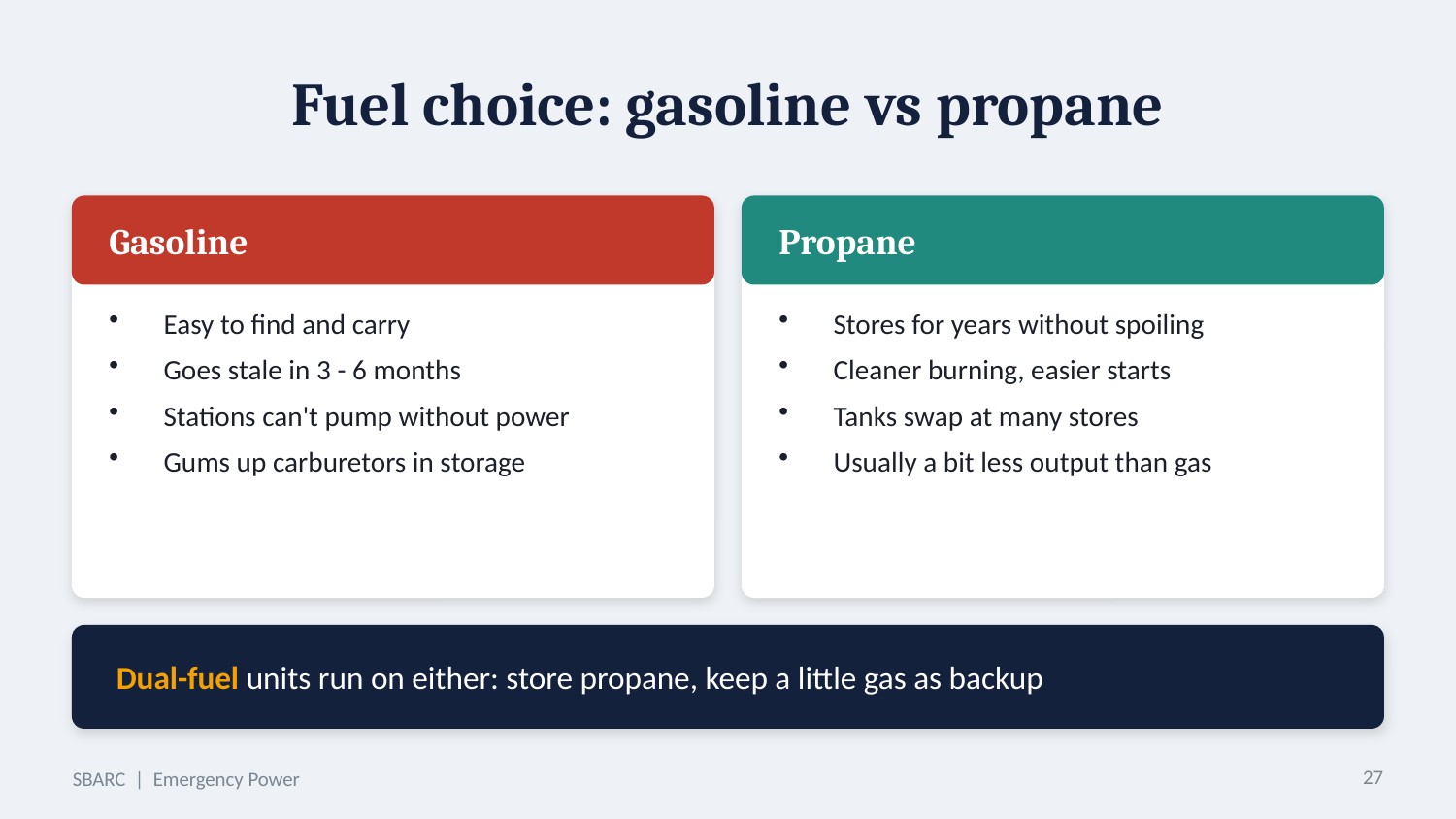
On fuel, Dornlas prefers propane, and he does not plan to keep gasoline around. Gasoline goes stale in three to six months, gas stations cannot pump without power, and stored gas gums up carburetors. Propane stores for years without spoiling, burns cleaner, starts easier, and tanks swap at many stores, though output is usually a little lower than on gasoline. He told a cautionary tale about the day the utility shut off his power and his wife wanted to use the toaster, only to find the propane tank empty. Check your tank before you need it.
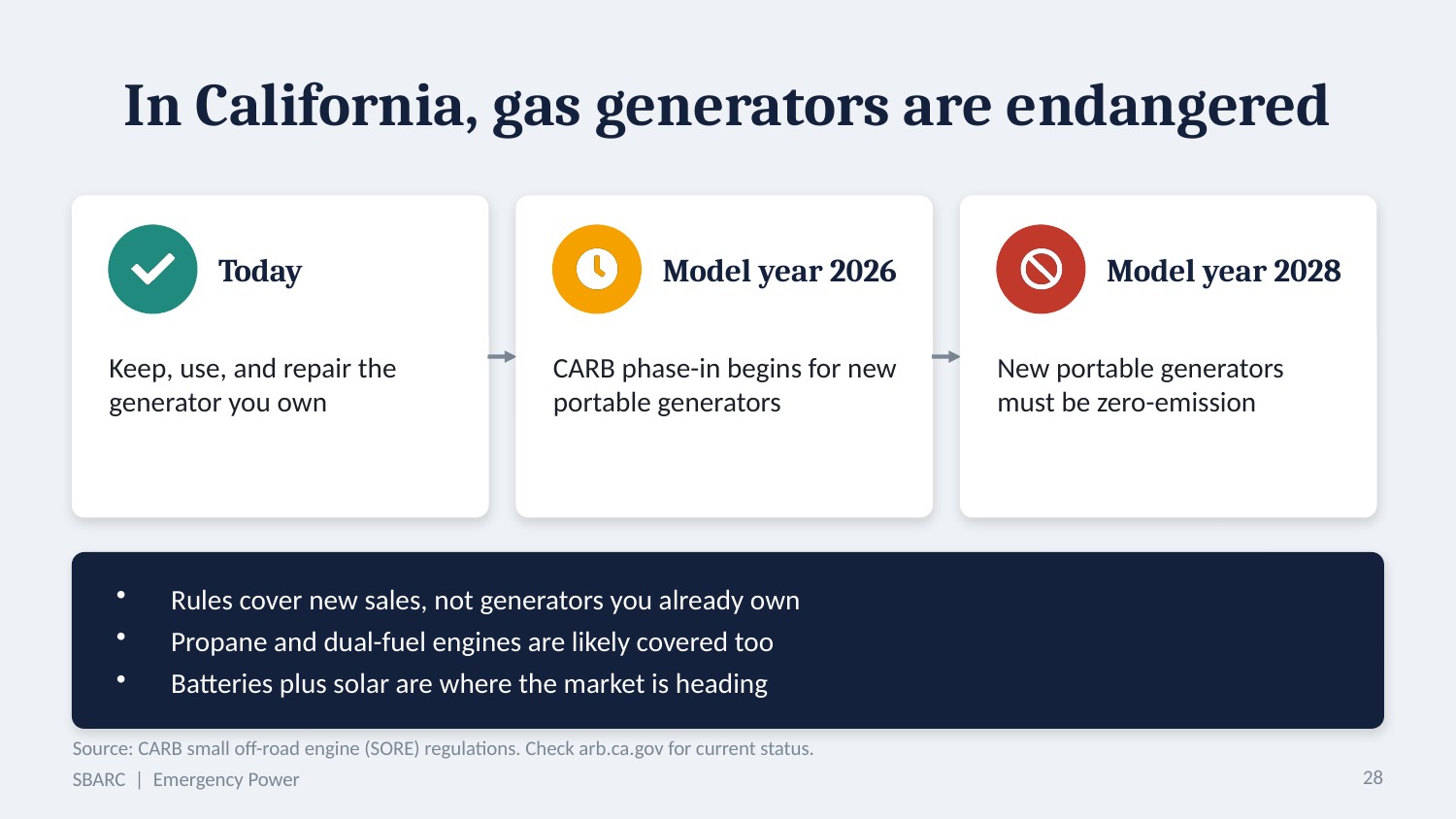
He also delivered some news: gasoline generators are an endangered species in California. Under the state's small off-road engine rules, set by the Air Resources Board, the phase-in for new portable generators begins with the 2026 model year, and new portable generators must be zero-emission by model year 2028. Dornlas put the odds of a fuel-burning generator meeting that standard at pretty close to zero. The rules apply to new sales, so members may keep, use, and repair the generators they own. Propane and dual-fuel engines are likely covered too, though details and enforcement have been changing and members should check the Air Resources Board's website. A member noted that Costco still sells a dual-fuel model for now. The direction, Dornlas said, is that batteries plus solar are where the market is heading.
Generator Safety
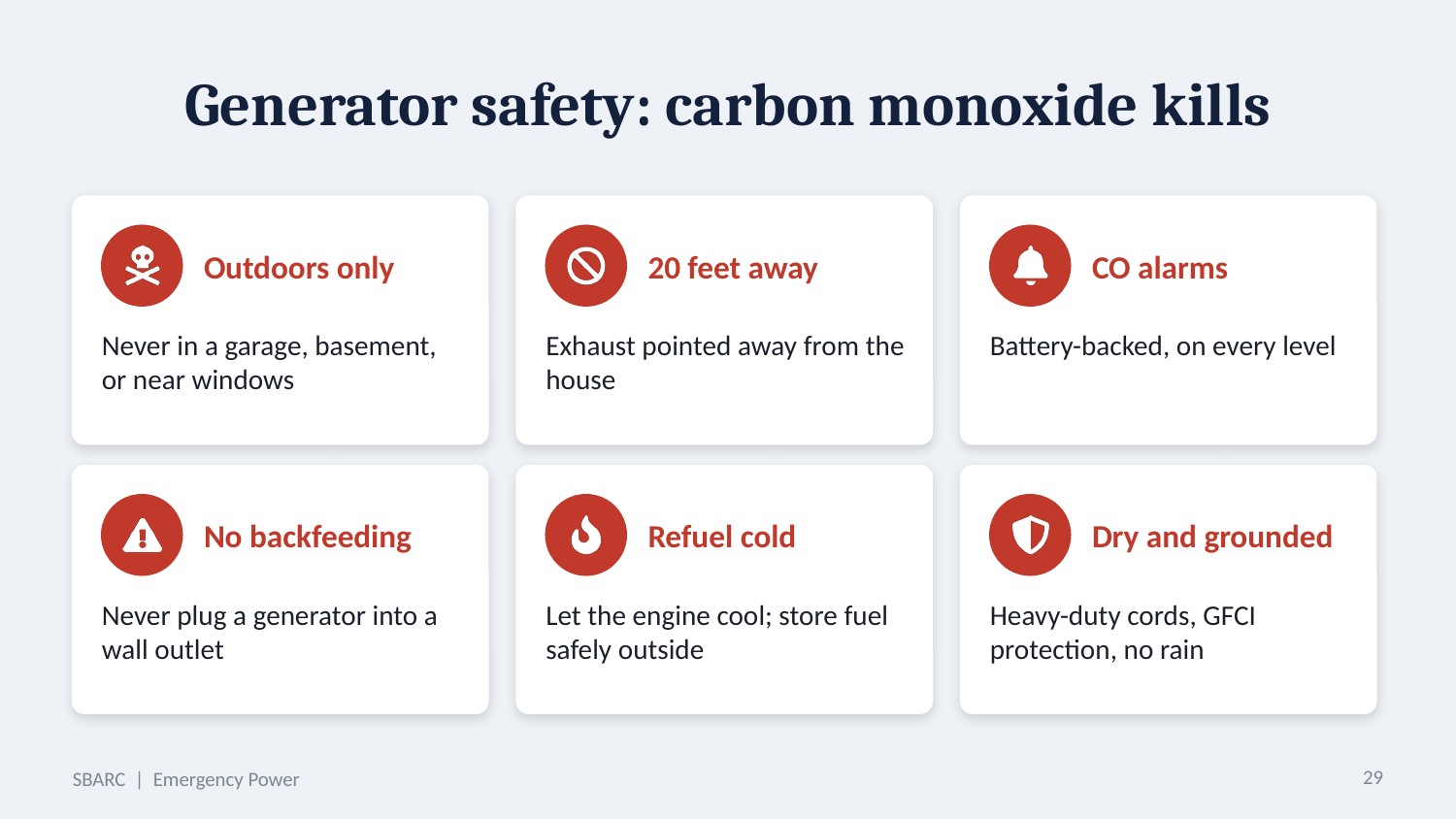
The most serious danger is carbon monoxide. Dornlas's rules: run generators outdoors only, never in a garage, a basement, or near a window; keep them 20 feet from the house with the exhaust pointed away; make sure battery-backed CO alarms are working; let the engine cool before refueling and store fuel safely outside; and keep the generator dry and grounded, with heavy-duty cords and GFCI protection. With an El Niño on the way, he pointed out, a generator running on the deck in pouring rain is not a good combination. That, he said, is one reason so many people are buying power stations.
The other cardinal rule is never to backfeed. Do not plug a generator into a wall outlet, and never use a so-called suicide cord, a cable with a male plug on both ends, which can electrocute utility workers. There are three ways to connect a generator to a house. Extension cords to a few chosen appliances are the simplest. The gold standard for a portable unit is a transfer switch or a panel interlock, installed by a licensed electrician with a permit. The top tier is a standby generator with an automatic switch. A friend of Dornlas's on Crestmoor has one, and it took over smoothly when the power went out Saturday. His one complaint is that such units run whether or not anything is drawing power, wasting fuel, which is one reason he prefers batteries.
A hybrid approach appealed to many members: run the generator for a few hours, recharge the batteries, and shut it off. It saves fuel, cuts noise and RF interference, and keeps the engine away from your antennas and your ears.
Solar: Recharging Without Fuel
Solar is what lets a battery system last past the second or third day. The chain is panels, a charge controller, and a battery, and an MPPT controller gets the most from the panels, especially when it is cool or cloudy. Dornlas's practical points were to match panel voltage to the controller's limit, fuse the battery side, and avoid shade, since one shaded cell can sharply cut a panel's output. There is a ham-specific wrinkle too. Some controllers raise the noise floor on HF. Members have heard solar noise in their radios on Field Day. Folding panels deploy in minutes and are easy to move away from antennas.
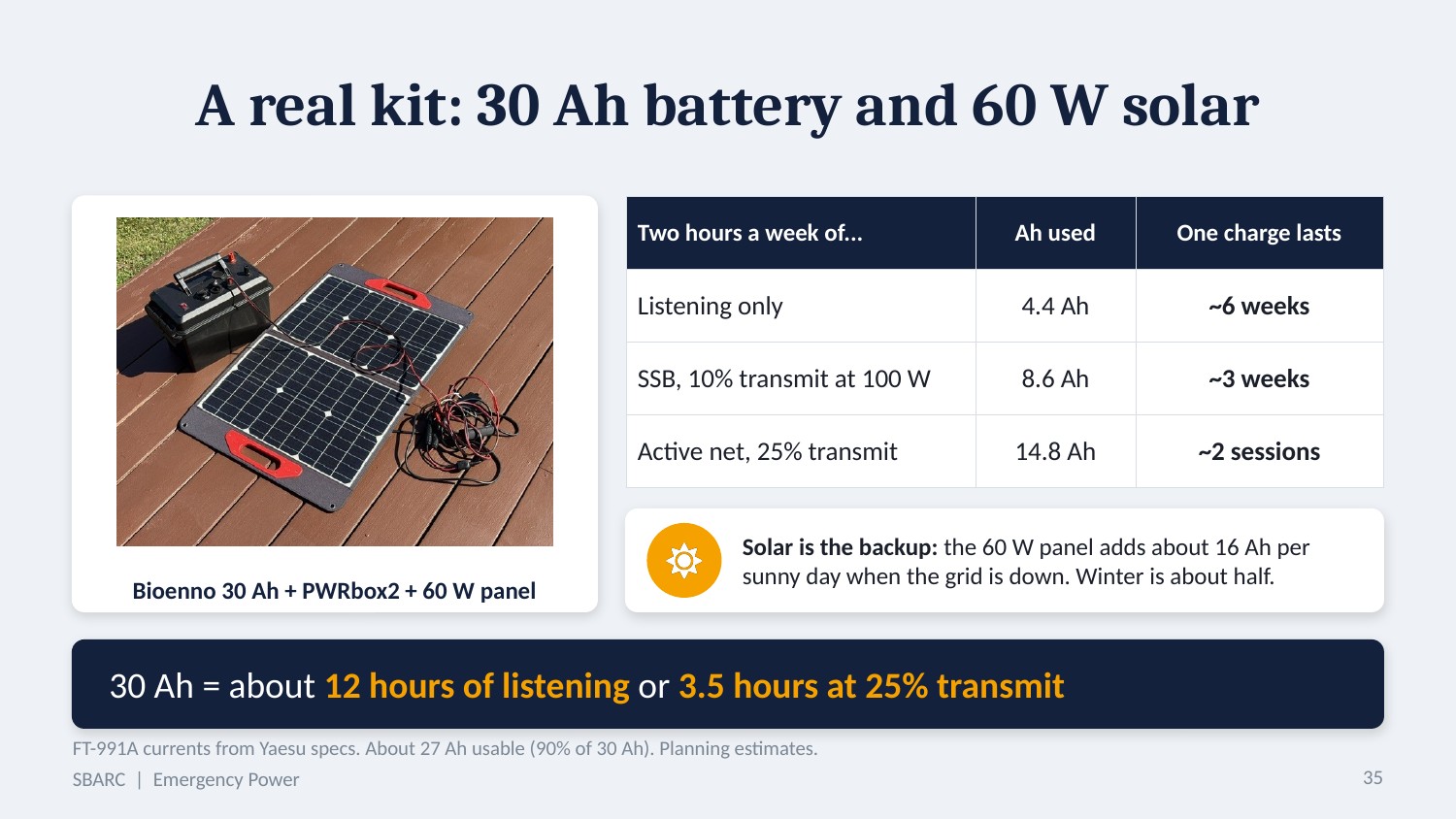
He showed his own portable kit: a 30 amp-hour Bioenno lithium battery in a Powerwerx PWRbox2 power box, with a 60-watt folding solar panel. In planning terms, 30 amp-hours is about 12 hours of listening with an FT-991A, or about 3.5 hours at 25 percent transmit, and the panel can add about 16 amp-hours on a sunny day. He uses the kit a couple of hours a week and recharges it only about every other month. The panel is his backup for when the grid is down, not how he normally recharges it.
Matching Gear to Power Sources
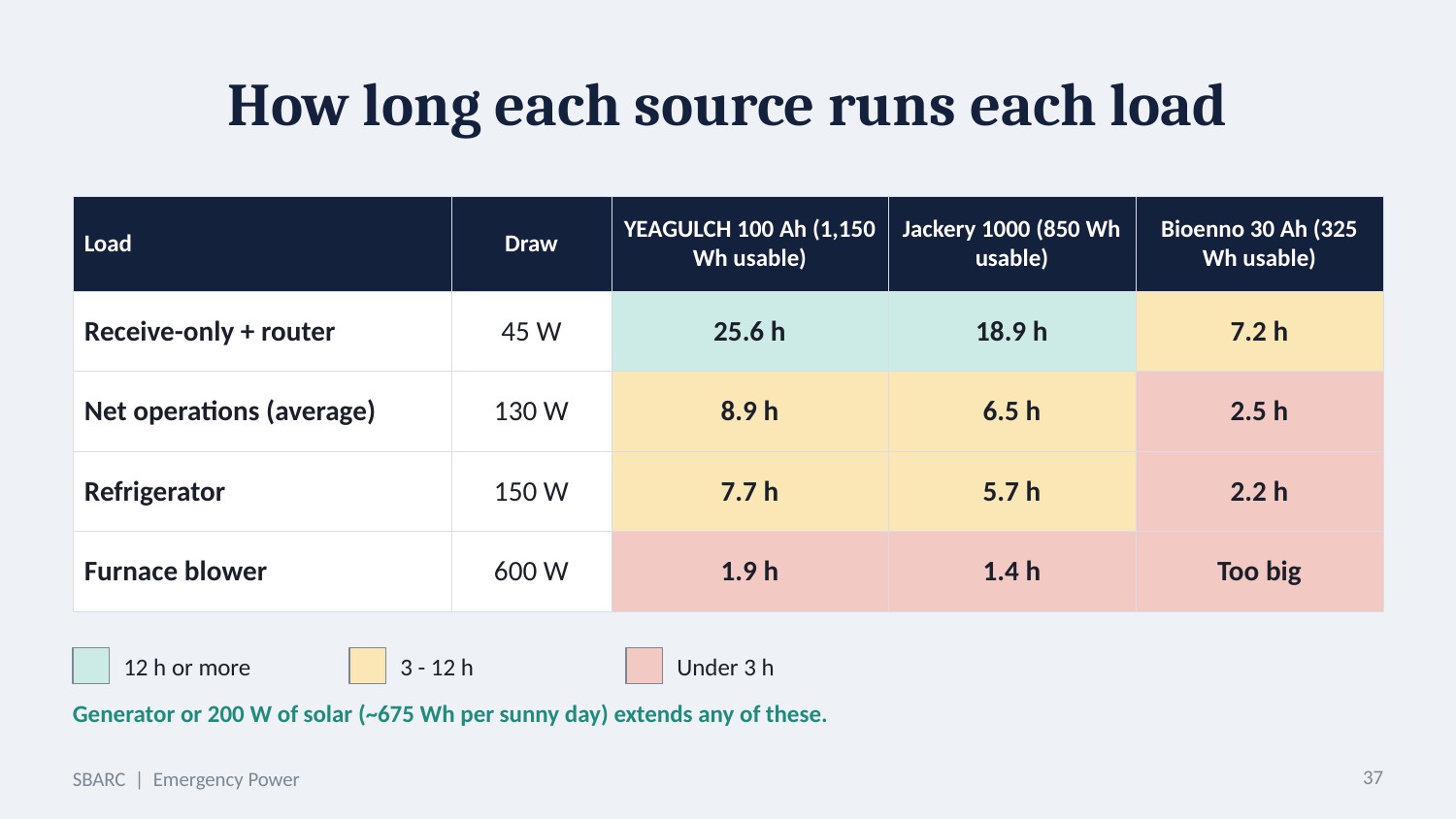
To pull it together, Dornlas lined up what equipment draws against what popular battery products can supply. A furnace blower pulls about 600 watts. The FT-991A draws about 317 watts transmitting and 30 receiving, its VHF/UHF side about 207 transmitting, a refrigerator about 150, a router and modem about 15, and LED lights 8 to 15 watts each, which is why lighting stretches so far. He then compared how long three sources would run each load: a 12.8-volt, 100 amp-hour lithium battery, a Jackery Explorer 1000, and a 30 amp-hour Bioenno. Listening and lighting are easy for all three, a net or a refrigerator is a shorter job for the small battery, and a furnace blower is too much for any of them. A generator or solar fills the gaps.
Whole-Home Priorities, and a Caution
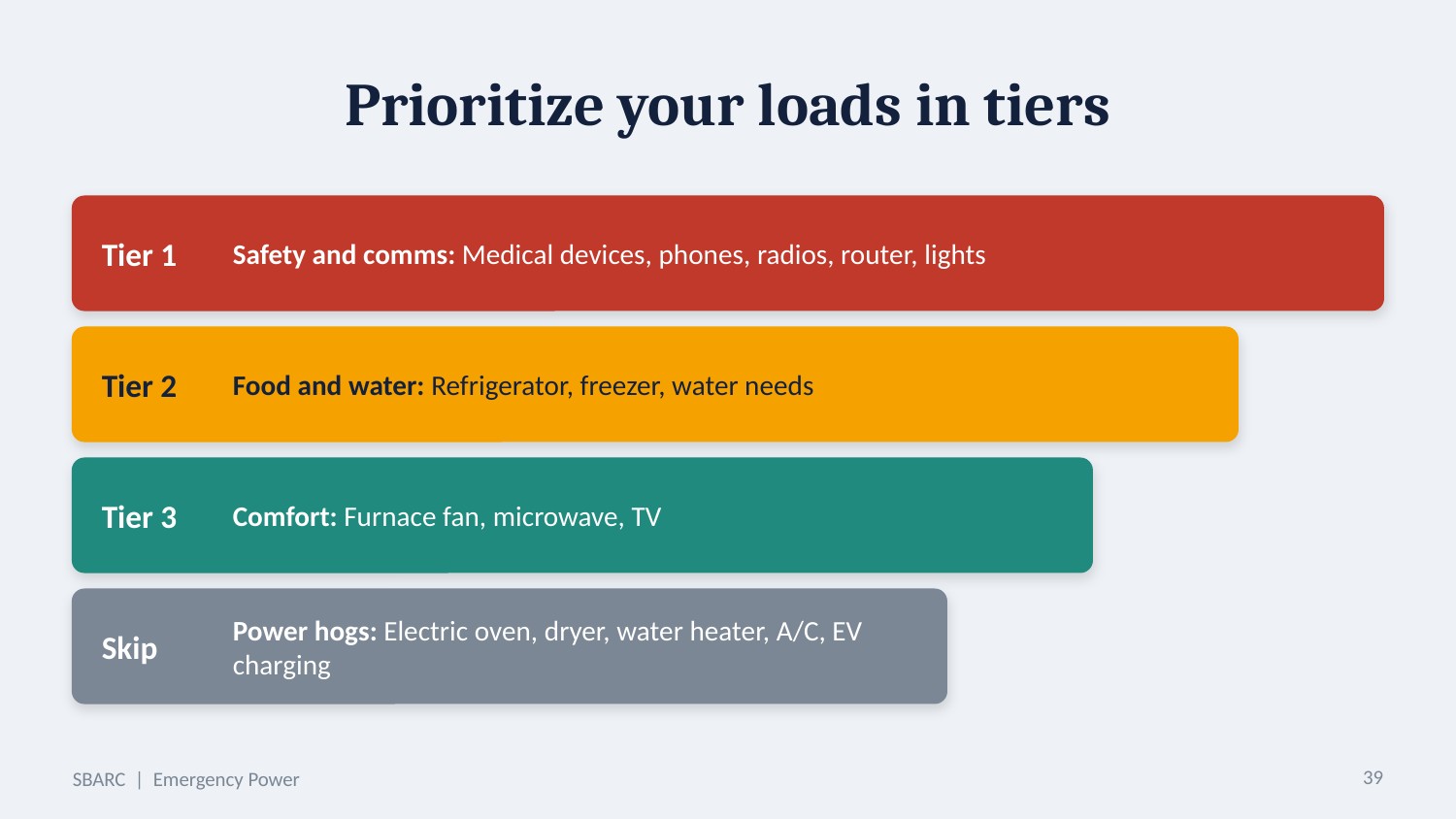
Nobody can run a whole house on a small system, so Dornlas suggested deciding in advance what comes first. Tier one is safety and communications: medical devices, phones, radios, the router, and lights. Tier two is food and water, meaning the refrigerator, freezer, and water needs. Tier three is comfort, such as the furnace fan, microwave, and TV. The power hogs are skipped: the electric oven, dryer, electric water heater, air conditioning, and EV charging.
That list set off the evening's liveliest side conversation. With the state pushing toward all-electric construction, members worried about electric water heaters, which need a 240-volt circuit and an electrician, and which, unlike gas models, stop working in an outage. Several members still have hot water, if not a furnace blower, when the power goes out. Dornlas encouraged members to make their opinions known.
A related story came from a member's neighbor, who has about 30 solar panels and home batteries. During Tuesday's heat, she told the member, the utility drew down her batteries as part of a program she says she was enrolled in by default. As relayed, it is a program homeowners are in unless they opt out. Dornlas suggested anyone with a home battery check whether it is enrolled and what that does to their reserve. Solar panels also help far less in an outage on a heavily overcast day. He closed the section with three levels of backup: a power station and cords as a starter, a generator with an interlock as a step up, and a home battery with solar as the best.
Test It Before You Need It
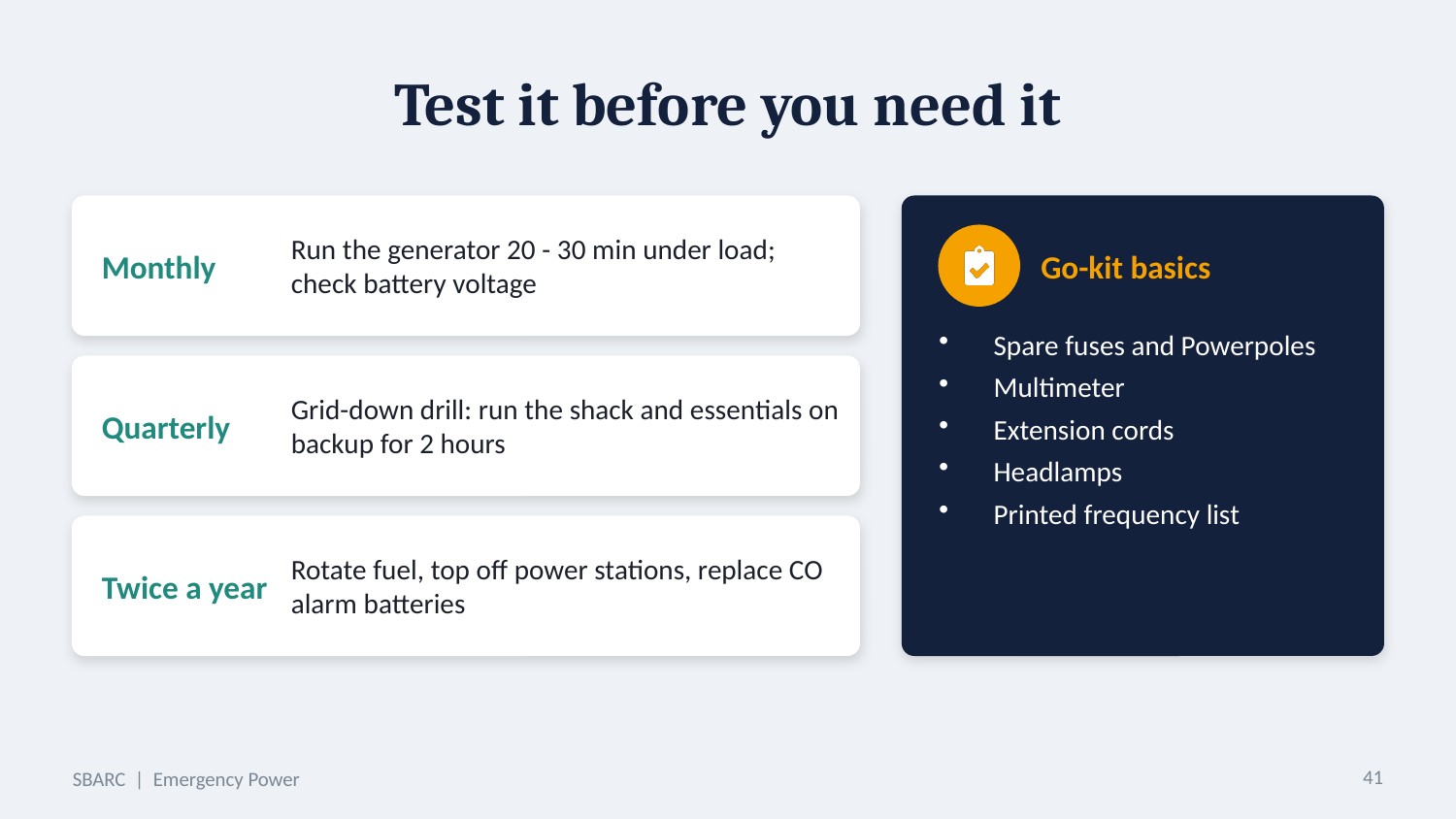
Preparation only counts if it works. Dornlas's schedule: monthly, run the generator 20 to 30 minutes under load and check battery voltage. Quarterly, run a grid-down drill with the shack and essentials on backup for two hours. Twice a year, rotate fuel, top off power stations, and replace CO alarm batteries. He promised to start up his own dual-fuel generator for exactly that purpose. A go-kit should hold spare fuses and Powerpoles, a multimeter, extension cords, headlamps, and a printed frequency list. Dornlas, to laughter, had forgotten his headlamps.
The takeaways:
- Do the load math first, and decide what you truly need.
- LiFePO4 batteries plus a fused Powerpole bus are the foundation of a shack.
- Test power stations for HF noise before depending on them.
- Generators: outdoors, 20 feet out, working CO alarms, and no backfeeding.
- Practice the drill before the outage.
Show and Tell
Dornlas, whom a contractor once dubbed the Lord of the Lights because he is a photographer at heart, passed around an assortment of lighting. There was a solar light that packs down flat for a backpack and recharges in the sun. Buying one is also a donation: the maker supports World Central Kitchen, which gives them away where they are needed. There were Costco solar lanterns with lithium batteries inside, which the room agreed were bright, and rechargeable flashlights from a Costco three-pack that charge over USB-C and can also run on three AAA cells. He swapped in Amazon rechargeable AAAs that charge through the same port, so he has a backup. The point, he said, is that every time the power goes out, the batteries in the old lanterns turn out to be dead. He also keeps a white-gas lantern from his Scout days.
Members traded battery stories as well: a photo-lab owner who used to hand out AA cells from disassembled single-use cameras, a Dyson vacuum whose battery died after a few years, and a tip to look on YouTube for people who rebuild packs from salvaged laptop cells.
A Free App for Digital Radio
Ralph Kugler, KC6YDH, closed the program with something new, which Dornlas called interesting even if it is not strictly radio. QSO1.net is a free app for Windows and Android that connects users to the digital amateur-radio voice networks over the internet, with no radio and no special hardware. It reaches DMR through the Brandmeister network, plus All Star, EchoLink, D-STAR, Fusion, and P25, which together link thousands of repeaters worldwide. Users talk through the computer's microphone and speaker, and a headset helps keep room noise out. To transmit, press the space bar or the key-up button on the screen.
What impressed Kugler most was the audio. Others have tried to build something like this for years, but the voice codecs never sounded good. This one does, in both directions. The developer, a ham Kugler does not know, has been updating it almost daily since it appeared about six months ago and adding networks. It is free, though donations are accepted, and Kugler made one.
He gave a live demonstration from the meeting room, keying up the Northern California talk group, which goes out through Brandmeister over about 50 repeaters across the region, including the Mount San Bruno DMR repeater. The audio came back clear, and Kugler said he was pleasantly surprised to reach it from inside the room. Users control how widely they are heard: enter a single repeater's ID, such as the San Francisco repeater, and the signal goes out only there; choose a regional talk group and it reaches dozens; or join a special-interest group. There are about 20 DMR repeaters in the Bay Area alone. Some paperwork is required. DMR needs an ID, obtained by sending a copy of your license as a PDF, and the other networks have their own registrations.
Club Business and What's Ahead
Dornlas thanked members who have paid their dues and reminded the rest that there is still time. Checks can go to him or to the treasurer, Steve, who could not attend. He asked every member, paid or not, to log in to the club website as usual and complete the renewal form, which lets them update phone numbers and other contact details. Anyone who has trouble, as one member did this week, should let him know.
Under the revised bylaws adopted last month, nominations for officers were taken at the meeting, with the vote set for next month. The proposed slate keeps Eric as vice president, Steve as treasurer, and Larry as director. Matthew is stepping down as secretary after serving, and Jerry is nominated to replace him and Dave is once again up for president. Nominations were closed, and Dornlas invited anyone who would like to help during the year to step forward. He recalled a past election held in the rain outside a pizza parlor, because the alternative was fighting a crowd of soccer players for seats inside.
A member asked whether the city's Emergency Operations Center is equipped to call in volunteer hams, which turned into a discussion of San Bruno's CERT programs Members trained years ago who did not stay involved may have lapsed, and a refresher is being discussed. A member active in South San Francisco's CERT program was on hand, and the city is working on a plan that includes shelter supplies, among them a trailer of cots packed 25 to a bundle, bought with utility funds and owned by the city for use with the Red Cross.
Dornlas said he would like the club to become more active in ARES and invited anyone willing to take the lead. He plans to teach the license class again in January, which means updating his slides for the new question pool, and he is looking for help. He also needs licensed, CERT-trained volunteers to help with radios at the final session of the current CERT series later this month. He will be tied up that day with a Friends of the Library book sale.