
Band Conditions
How the sun and Earth's magnetic field are treating the ham bands, from NOAA's Space Weather Prediction Center. Updated every 20 minutes.
Solar flux is moderate and the magnetic field is quiet. Tonight, 80–40 m are your best bets; 17–15 m and 12–10 m are mostly closed.
From NOAA at 12:40 AM Pacific. A rule of thumb from the numbers below, not a promise for any one path: the bands surprise everyone, so get on and listen.
| Day | Night (now) | |
|---|---|---|
| 80–40 m | Fair | Good |
| 30–20 m | Good | Fair |
| 17–15 m | Fair | Poor |
| 12–10 m | Poor | Poor |
6 m and up: mostly local and repeater range. Along the coast, warm air over cool air can carry 2 m and 70 cm a long way: see the tropo forecast.
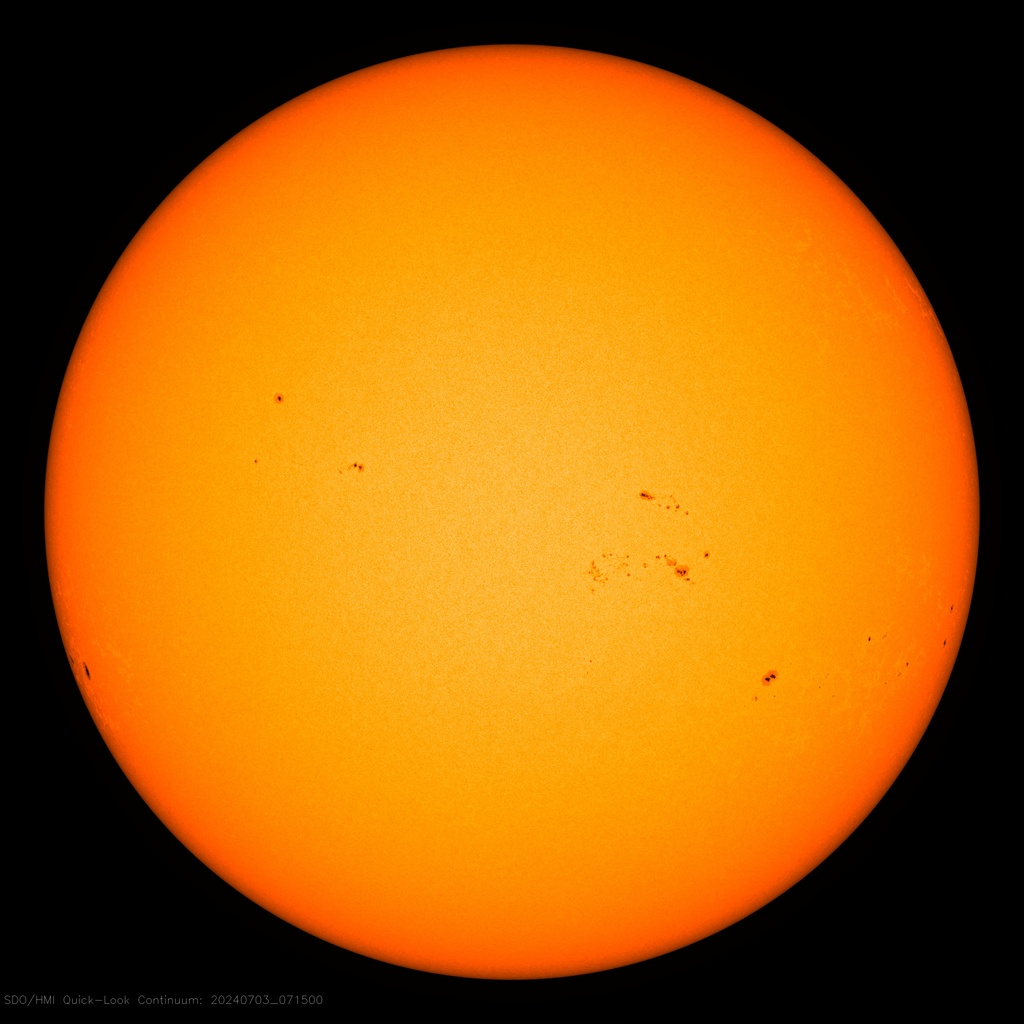
The sun right now
The sun as your eyes would see it (through a safe filter). The dark specks are sunspots: cooler, magnetically tangled spots. More sunspots usually means a higher solar flux and better high bands. Today's sunspot number is 30.
Live pictures from NASA's Solar Dynamics Observatory, a satellite that watches the sun around the clock. They're updated every 15 minutes or so.
Sunspots: what the numbers mean
The sunspot number runs from 0 on a spotless day to 200 or more at the top of a busy cycle. Higher numbers mean the ionosphere can bounce higher frequencies, so the high bands open up. Today it's 30.
A quiet sun. 40 and 80 m do the work, 20 m is open in daylight, and 15 and 10 m are mostly empty (apart from summer sporadic-E). A great time for the low bands.
20 m is open worldwide in daylight; 17 and 15 m open on good days; 10 m only now and then.
17 and 15 m are open most days, and 10 m opens to the south and across the Pacific on some days.
10 m opens worldwide during the day and small stations work the world. 20 m stays open into the night.
The top of the cycle: 10 m is wide open and 6 m can open around the world. Expect more flares and storms too.
The solar cycle: where we are
Sunspots rise and fall over about 11 years. This cycle (Cycle 25) peaked in Oct 2024, at about 161 (the smoothed average), higher than the last cycle's peak of 116. Now the numbers are falling. NOAA expects the next minimum around 2030; after that, Cycle 26 should bring the high bands back in the early-to-mid 2030s. Until then, 10 and 15 m will open less often each year, and 40 and 20 m become the everyday bands.
Monthly sunspot numbers and the forecast from NOAA's Space Weather Prediction Center. Point at the chart to read any month.
The numbers
The next few days
NOAA's forecast for the magnetic field and for flares. A quiet forecast is good news for HF.
Chance of a flare that fades HF: 1%
Chance of a flare that fades HF: 1%
Chance of a flare that fades HF: 1%
What it all means
Why the sun matters
HF signals (160 through 10 m) travel long distances by bouncing off the ionosphere, layers of charged air 50 to 250 miles up. The sun's ultraviolet light charges them. More sun (high solar flux) means the ionosphere can bounce higher frequencies, so 15, 12 and 10 m come alive. A quiet sun leaves those bands empty, and 40 and 20 m do the work.
Day and night
In daylight the higher bands (20 m and up) carry best, while a low layer soaks up 80 and 40 m. After dark that layer disappears: 80 and 40 m open up for long distances and the higher bands close. The hour around sunrise and sunset (the “grey line”) is often the best of the day.
Storms and flares
A solar flare hits within minutes and blacks out HF on the sunlit half of the Earth, usually for less than an hour. A geomagnetic storm comes a day or two after the sun throws off a cloud of particles; it brings fading and noise for a day or more, and aurora that 6 and 2 m operators love.
How we rate the bands
The Good / Fair / Poor table is a rule of thumb worked out from the solar flux, the K-index and any flare alert, the same idea as the panels many ham sites show. It describes the band in general, not a particular path. The real test is to listen, or to call CQ and see who hears you:
See it for yourself
- PSK Reporter map: who's hearing FT8 and other digital signals, live
- Reverse Beacon Network: where your CW is being heard
- Tropo forecast for the West (2 m and 70 cm)
- Aurora forecast
- NOAA: space weather for radio, where these numbers come from